







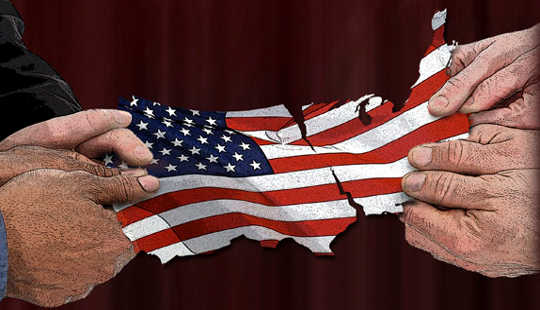
A recent study reveals how political affiliations influence preferences for science books among American readers. While interest in science remains high across party lines, liberals and conservatives are drawn to different subjects, with liberals favoring basic sciences and conservatives preferring applied sciences. This trend highlights the growing polarization within scientific communication and its implications for public policy.
In This Article
- How does political affiliation affect science book preferences?
- What themes do liberals and conservatives gravitate towards?
- How were the reading habits analyzed in the study?
- What are the implications of these preferences for scientific communication?
- What risks arise from the polarization in science reading?
Our preferences for liberal or conservative political books also attract us to different types of science books, according to a new study.
The result supports observations that the divisiveness of politics in the United States has spread to scientific communication as well.
While readers on the political left and right exhibited shared level of interest in science books, an analysis led by the University of Chicago’s Knowledge Lab and the Social Dynamics Lab at Cornell University determined that these groups are largely drawn to different subjects. Liberals prefer basic sciences, such as physics, astronomy, and zoology, while conservatives prefer books on applied and commercial science, such as medicine, criminology, and geophysics.
“One potential interpretation is that liberal readers prefer scientific puzzles, while conservative readers prefer problem-solving.”
Even in disciplines that attract both conservative and liberal readers, such as social science and climatology, they typically cluster around different individual books—a reflection of political polarization within the sciences most relevant to public policy. The findings appear in Nature Human Behaviour.
“Interest and respect for science remains high across political boundaries in the United States, suggesting that it could be a crucial bridge for crossing partisan divides in America,” says James Evans, professor of sociology at the University of Chicago, senior fellow of the Computation Institute, and director of Knowledge Lab.
“However our study finds that within science, there are clear differences in readership of specific topics and books, suggesting that science is not immune to partisanship and the ‘echo chambers’ of modern political discourse.”
Red reads, blue reads
Researchers built a network from more than 25 million “co-purchases” and nearly 1.5 million books from the Amazon and Barnes & Noble online stores. After collecting data from “Customers Who Bought This Item Also Bought” recommendations, the researchers could analyze the scientific experiences of readers who purchase liberal or conservative books.
Initial analysis found that readers of liberal and conservative books were more likely to purchase books on science than other non-fiction topics, such as arts and sports—a difference largely driven by interest in books on social science. However, co-purchases revealed that readers on opposite ends of the political spectrum were far more polarized for science than in arts and sports, less likely to buy and read the same science books.
“Our study found that ‘blue’ readers prefer fields driven by curiosity and basic scientific concerns, such as zoology or anthropology, while ‘red’ readers prefer applied disciplines such as law and medicine, and with disciplines that patent more intensively,” says first author Feng Shi, a former postdoctoral scholar with Knowledge Lab, currently at the University of North Carolina. “One potential interpretation is that liberal readers prefer scientific puzzles, while conservative readers prefer problem-solving.”
Even when left- and right-leaning readers converged upon a scientific discipline, such as paleontology, environmental science, or political science, they rarely shared preferences for the same books within the subject area. Conservative choices tended to cluster on the periphery of a discipline, relatively isolated books that are often bought with each other, but not with other books in the subject area. Books preferred by liberals are less clustered, more diverse, and lie closer to the center of a given discipline.
Blame the algorithms?
The authors acknowledge that the recommendation algorithms employed by online bookstores, and used by this study to create the co-purchase network, could augment polarization by reinforcing previously established connections, proposing science book sales to new politically active customers. These technologies could contribute to the “echo chamber” effect observed in today’s political culture, where Americans are increasingly drawn to voices and products that confirm their own prior beliefs.
These observations also reflect growing politicization of scientific topics such as climate change, evolution, and genetically modified organisms, throwing doubt upon areas of scientific consensus and weakening science as a neutral, evidence-based driver of public policy decisions. The authors suggest that improvements in scientific communication are needed to push back against this polarization.
“Our work adds urgency to the search for approaches to the communication of scientific information that counter selective exposures to ‘convenient truth’ and increase potential for science to inform political debate,” says Michael Macy, the professor and director of the Social Dynamics Laboratory at Cornell University.
“Our findings point to the need to communicate scientific consensus when it occurs, helping scientists find common cause with their audiences and adding public debate alongside scientific analysis to clarify the distinction between facts and values.”
Source: University of Chicago
Further Reading
-
The Righteous Mind: Why Good People Are Divided by Politics and Religion
This book speaks directly to the article’s core finding that political identity shapes how people approach knowledge, even when both sides value science. It helps explain why liberals and conservatives can enter the same public debate with very different moral instincts and still come away trusting different kinds of evidence. For readers trying to understand the deeper psychology behind polarized science reading, it adds an important layer.
Amazon: https://www.amazon.com/exec/obidos/ASIN/0307455777/innerselfcom
-
Why Trust Science?
This title pairs well with the article because it examines what gives science authority in a culture where trust is fractured by ideology and media habits. It is especially relevant to the article’s concern that scientific communication is no longer received as neutral across political lines. Readers interested in how science can still serve public life despite growing skepticism will find it highly relevant.
Amazon: https://www.amazon.com/exec/obidos/ASIN/0691212260/innerselfcom
-
Merchants of Doubt: How a Handful of Scientists Obscured the Truth on Issues from Tobacco Smoke to Global Warming
This book broadens the article’s theme by showing how scientific issues become politically distorted and sorted into competing camps. It helps explain why certain fields, especially those tied to public policy, become battlegrounds where ideology influences what people choose to read and believe. That makes it a strong companion for an article about partisan divisions in science communication.
Amazon: https://www.amazon.com/exec/obidos/ASIN/1608193942/innerselfcom
Article Recap
The study indicates a clear divide in science book preferences between liberals and conservatives, highlighting the need for improved communication strategies in science. Addressing this polarization is crucial for fostering informed public discourse on scientific issues.
#InnerSelfcom #PoliticalPolarization #ScienceCommunication #BookPreferences #CognitiveBias #EchoChamber #PublicPolicy #LiberalConservative #ScientificConsensus