






In This Article
- How rules differ from guidelines and social conventions
- When one person’s choices may not be right for everyone
- How social expectations can weaken authenticity and self-trust
- How conscious choices create greater freedom and possibilities
Writers will often be told not to use clichés. In other words, don't use terms or phrases that have been used over and over again. As a writer, I find that rule limiting. After all, do we constantly need to reinvent the wheel? Why fix something if it isn't broken?
While I've just used two clichés, I got my point across in a few words and in a way that people relate to immediately. I could have taken several paragraphs to explain the concept, but if someone has already done it concisely, then why not just go with that?
Written and Unwritten Rules
There are a lot of rules in our society, whether written or unwritten, and most of them have been created by well-intentioned people. However, we are all unique while at the same time being very similar. Consequently, not all rules are one-size-fits-all. I've often felt that some rules need to be broken. And if not broken, they at least need to be stretched.
Perhaps what needs to be reconsidered is not the rule itself, but the way we relate to rules. Some rules protect people and serve the common good. Others are guidelines that allow room for individual circumstances. And some are simply social conventions that have been repeated for so long that we no longer stop to ask whether they make any sense.
I prefer to consider many rules as guidelines. For example, I was telling someone the other day that I have a rule for myself that if I'm going somewhere that's less than a mile away, I walk, and if it's more than a mile, I take the car.
Then I realized that it's not a rule, it's a guideline. A rule tends to be set in stone and not flexible at all. Yet life is meant to be flexible, to flow, and not to be set rigidly in a cast or mold.
Thus, in my example with driving my car, there are instances where I will take the car when appropriate even if it's less than a mile because perhaps I need to carry a heavy box, or I only have five minutes to get there.
And, of course, the "when appropriate" part is the tricky part. Once we decide that rules can be flexible, the decision becomes subjective. some people may make decisions based not on the highest good, but only on their own desires. As we can see in the world around us, when people break rules without concern for the highest good, the results are less than desirable for everyone, including the person breaking the rule.
Flexibility does not mean ignoring the consequences of our actions. It means being aware of the purpose behind a rule, the circumstances of the moment, and the effect our choice may have on ourselves and others.
Rules That Are Meant to Be Broken?
So what rules are meant to be broken?
As I ask myself that question, I recall that as a child there used to be a saying: blue and green should never be seen except in the washing machine. So that was a rule, while not a legal one, that one should not wear blue and green together. How boring. How limiting. As someone who loves to play with colors in the clothes I wear, I know that sometimes blue and green work beautifully together.
Now, of course, that was a silly rule, yet it existed anyway. A lot of silly rules have to do with human behavior, with being proper, with not rocking the boat, or with not upsetting "others" or societal standards.
Some rules are overreactions to something that has happened. Others come from fear, habit, tradition, or someone's desire to remain in control.
Parents will sometimes overreact and create a rule for their child. Their intention may be good. They may be trying to protect the child from harm or perhaps protect themselves from stress. Yet the rule may end up forcing the child into a box or creating a restriction that limits originality, creativity, and self-trust.
If a child is always told not to climb trees because they might fall, they may learn that avoiding all risk is preferable to adventure and discovery. Of course, there may be times when climbing a particular tree is unsafe. The question is whether the decision is based on awareness of the actual situation or on a general fear of everything that might go wrong. And sometimes rules are also counterproductive. Telling a child "don't climb that tree" may make the child want to climb it even more.
Many of us, adults as well as children, have a tendency to resist being told what to do. And sometimes correctly so.
Often, when someone tells us what to do, they are telling us to do what they want us to do, regardless of whether it is best for us. It is best for them, so that is what they want. Fair enough, if they are telling themselves what to do. But their preference is not automatically valid for us or anyone else.
Who's in Charge?
We are each in charge of our own life. No one else is in charge of it.
They may think they are. They may want to be. They may try to be. But the bottom line is that we are in charge of our own life, our own decisions, and our own direction.
We can listen to advice. We can learn from others, which I highly recommend, but the choice needs to be ours.
Just because someone else has made a decision, or created a rule in their life that works for them, does not necessarily mean that decision will work for us. We can observe the behavior and decisions of others, we can reflect on the life lessons they have gone through, and then we decide whether those lessons apply to our own circumstances.
Yet we may have a tendency to think that rules—or guidelines—are one-size-fits-all. Unfortunately, that attitude can create many problems.
For example: A person decides that being a vegetarian is the best nutritional choice, and consequently, from their perspective, everybody else should be one too. Or someone tries a new diet and suddenly becomes the flag bearer for that diet, trying to convince friends and family that this is the only way to health.
This applies to so many other things: religion, fashion, careers, relationships, education, politics, and even spirituality. Whatever someone has decided is the right way for them is then imposed on others.
The problem is not that they have found something that works for them. The problem begins when they assume it must work for everyone else.
Variety Is the Spice of Life
You don't make a cake, at least not a very good one, with only one ingredient. Many ingredients come together to create something that is much better, or tastier anyway, than any one ingredient on its own.
In the same way, different lifestyles, opinions, genders, religions, and cultures come together to create a unique and varied whole.
Even for me, with the well-intentioned advice that I give through my writing and through my conversations, I need to leave space for the other person to be uniquely themselves. What works for me may not necessarily work for you or for everyone. The main thing is for each person to be true to who they really are.
As a woman, do you wear high heels because you genuinely like wearing them, or because you've been told that you should? As a man, do you wear a suit and tie because that is how you feel comfortable, or because it is expected of you?
These may seem like small decisions, but they reveal how easily social expectations become internal rules.
I recall having an epiphany when I was in high school. One morning, I looked at myself in the mirror as I was getting ready for school and thought that I looked horrible without makeup, eyeliner, mascara, and curled eyelashes.
Then it suddenly occurred to me that if I couldn't love myself the way I was, and could only love myself with artificial improvements, then I wasn't really loving myself. So I decided at that moment to stop wearing makeup, at least until I could love myself the way I was.
Since that time, I have rarely worn makeup. When I do, it is more as an enhancement, such as when I'm going to a special event like a wedding. It is a choice rather than a requirement or obligation.
So am I wandering away from the subject of rules? No, because rules about dress and appearance can be stringent and limiting. We do not all have to fit into the same cookie mold.
Do something because it pleases you, because it is something you enjoy, not because it is enforced on you by societal standards.
Be True to Yourself
I think one of the main reason I became an entrepreneur and owner of my own businesses was so I wouldn't have to follow somebody else's dress code and other rules. I hated wearing nylons. I did not like wearing high heels. I did not like having to put on makeup and appear a certain way because I was in somebody else's space.
Once I started publishing InnerSelf Magazine, in those days as a print magazine, people would come to the office and sometimes look at me a bit strangely because I walked around barefoot.
That was how I was comfortable. Since it was my office and my business, I didn't feel that anyone else had the right to tell me I had to wear shoes. I simply took my shoes off when I got to work because that was how I was comfortable. So if there was a rule that the business owner needed to wear shoes, I either was not aware of it or chose to disregard it.
Now, I'm not encouraging everyone to go out and break all the rules and laws willy-nilly. But I am suggesting that we apply awareness to our decisions and choices.
Are we choosing because we are being true to ourselves, or are we choosing because we are being true to some societal, parental, religious, professional, or cultural rule, guideline, or preference?
There is a difference between being considerate and being compliant. There is a difference between respecting others and abandoning ourselves. There is also a difference between following a rule because it serves the greater good and following it simply because no one has ever stopped to question it.
You Be You, and I'll Be Me
Each situation and each moment is unique. Thus, each one requires a pause of awareness as to what response serves us best without going against the greater good.
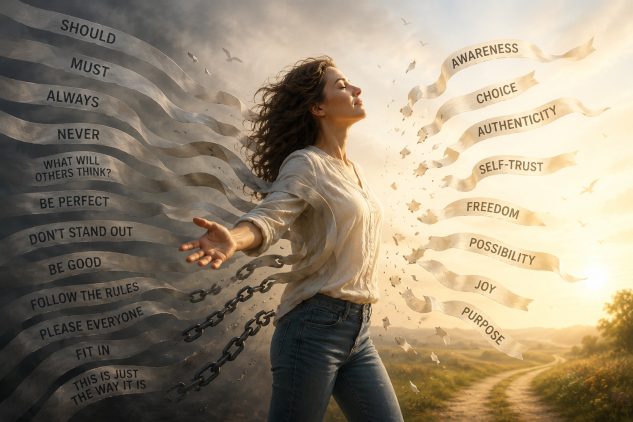
When rules become guidelines, we gain the ability to consider the actual circumstances rather than responding automatically. When guidelines become conscious choices, new possibilities emerge.
We may discover that we are more creative than we thought, more courageous than we believed, and more capable of trusting ourselves than we had been led to assume.
The purpose is not to reject every rule. It is to recognize which rules protect life and serve the common good, which ones should remain flexible, and which ones have outlived their usefulness.
The choices we make can then come from love and respect, both for ourselves and for the people around us.
You can be you, and I can be me. And together, rather than forcing each other into the same mold, we can create something richer, more compassionate, and filled with possibilities.
About The Author
 Marie T. Russell is the founder of InnerSelf Magazine (founded 1985). She also produced and hosted a weekly South Florida radio broadcast, Inner Power, from 1992-1995 which focused on themes such as self-esteem, personal empowerment, and well-being. Her articles focus on transformation and reconnecting with our own inner source of joy and creativity.
Creative Commons 3.0: This article is licensed under a Creative Commons Attribution-Share Alike 4.0 License. Attribute the author: Marie T. Russell, InnerSelf.com. Link back to the article: This article originally appeared on InnerSelf.com
Related Books:
-
The Courage to Be Disliked
About The Author
Ichiro Kishimi & Fumitake KogaPresented as a conversation between a philosopher and a young student, this engaging book challenges the belief that our lives must be shaped by our past or by other people's expectations. Drawing on the psychology of Alfred Adler, it encourages readers to develop the courage to choose their own path while respecting the freedom of others.
Amazon: https://www.amazon.com/exec/obidos/ASIN/1501197274/innerselfcom
-
The Book on the Taboo Against Knowing Who You Are
Author: Alan Watts
Alan Watts gently dismantles many of the assumptions society teaches us about identity, success, and conformity. Rather than accepting inherited beliefs as unquestionable truths, he invites readers to experience life with greater awareness, openness, and freedom.
Amazon: https://www.amazon.com/exec/obidos/ASIN/0679723005/innerselfcom
-
Practical Enlightenment
About The Author
Ariel & Shya KaneRather than encouraging readers to follow someone else's formula for happiness, the Kanes invite us to become aware of the beliefs, habits, and assumptions that quietly shape our lives. Through everyday examples, they show how greater awareness naturally leads to wiser choices, authentic living, and the freedom to respond to life rather than simply react to it.
Amazon: https://www.amazon.com/exec/obidos/ASIN/1943625018/innerselfcom
Article Recap:
Rules can protect the common good, but rigid rules and unwritten expectations can also restrict creativity, self-trust, and personal freedom. By treating appropriate rules as flexible guidelines and making conscious choices, we can remain true to ourselves while respecting the needs of others.
#RulesAndGuidelines #ConsciousChoices #PersonalFreedom
#SelfTrust #Authenticity #PersonalEmpowerment
#SocialExpectations #IndependentThinking #InnerSelfcom