







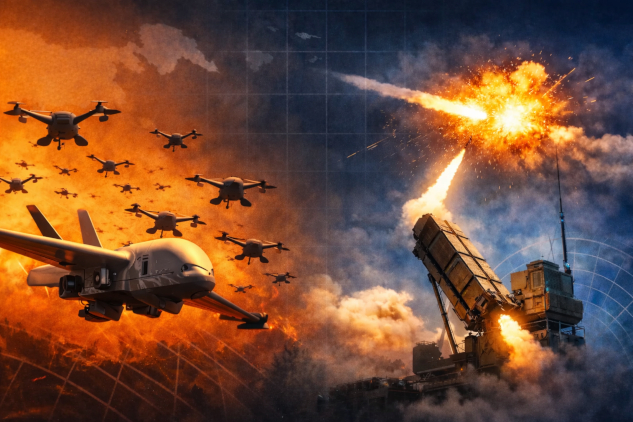
A veteran who read NATO's real nuclear war plans at the Fulda Gap sees a familiar pattern in the Iran war — and it's worse than what's being reported. The $20,000 drone has broken Israel's defense math. Interceptor stocks are dwindling. The escalation ladder is losing its middle rungs. And the nuclear risk is no longer abstract — it is becoming structurally plausible under continued escalation. What happens next doesn't stay in the Middle East. It reaches your wallet before the smoke clears
In This Article
- Why a veteran who saw NATO's real nuclear plans at the Fulda Gap is watching the Iran war differently than the pundits are
- The drone cost math that's quietly making the most expensive air defense system ever built unsustainable
- What Israel's behavioral shifts — not its official statements — are actually telling us about the state of the fight
- Why conventional force cannot produce Iranian compliance, and what that leaves on the table
- How the fiat money system is already at risk before a single nuclear weapon is used
- Who is quietly shaping American policy — and why that matters more than official statements
- Where the one remaining path away from catastrophe actually runs
Let me take you back to Germany, sometime in the 1960s, when I was stationed with a heavy artillery unit in the Fulda Gap — an outfit with nuclear capability, which was not something you discussed at the dinner table or anywhere else. A document went missing at the general's headquarters, and I was assigned to investigate. In the course of that investigation, I read things that were not meant for a young artillery officer's eyes, and I have been living with what I read ever since.
The plans were not abstract. They were not theoretical exercises in deterrence philosophy. They were operational. The doctrine was clear: conventional forces would likely be overwhelmed early in any Soviet push through the Gap. Tactical nuclear weapons were not the last resort in some distant, desperate scenario. They were integrated into the battle plan from the beginning. Escalation was not considered a failure of the strategy — it was the expected course of events beyond a certain threshold. The answer to "how far will we go" was already written down: all the way, on a schedule.
That understanding has never left me. And right now, watching the Middle East, I feel the same chill I felt reading those pages.
What We're Defending Has Changed
In the Fulda Gap, what stood behind that line was real: cities, populations, allied nations, the physical geography of Western Europe. You could make a dark moral argument for the calculus, even if the calculus was horrifying. People lived there. Civilization, in a concrete sense, was what we were holding on to.
Look at the Middle East today and ask yourself honestly: what is the line defending? It is not a homeland. It is not a population facing invasion. What is being defended is an economic architecture — the petrodollar system, the extraction flows, the shipping lanes, the arrangement by which American financial dominance is underwritten by control of global energy. That is nothing. The collapse of that system would cause real suffering for hundreds of millions of ordinary people who never asked to be stakeholders in the empire. But it is a different moral universe from defending Stuttgart.
Here is the trap, and it is the same trap it has always been: once a system becomes large enough and deeply enough embedded in everyday life, its defenses start to feel existential even when they are not. The fiat money system, the dollar's reserve status, the assumption of sovereign stability that lets people sleep at night — these are not abstractions to the family whose savings evaporate when confidence breaks. So the line in the sand has not moved. What stands behind it has. And the people making decisions about how far to go do not always pause to notice the difference.
Iran Cannot Be Bombed Into Compliance.
Let us deal plainly with the military reality that official commentary keeps dancing around. Iran is not a soft target. The geography alone should give pause to anyone who has studied terrain and defense: mountains, dispersal, hardened sites built with the explicit expectation of being struck. The Iranians have had forty years to watch what happens to countries that cooperate with Western demands and end up destabilized anyway, and they have drawn the obvious conclusions about vulnerability.
Then there is the ideological dimension, which military planners persistently underestimate because it does not fit neatly into targeting matrices. A regime that frames the absorption of damage as martyrdom does not respond to punishment the way a secular government calculating political cost does. You can strike their facilities, kill their commanders, degrade their infrastructure, and the result, historically, has been entrenchment, not capitulation. Every decisive strike on Iran in recent years has produced a harder Iran, not a softer one.
And then there is the proxy architecture, which is the piece that makes conventional thinking almost comically inadequate. The Houthis in Yemen. Hezbollah in Lebanon. Iraqi militias. These are not peripheral forces that disappear when you bomb Tehran. They are a distributed network, and you cannot bomb them into surrender because they have no capital, no single throat to grab. The fundamental problem is that tactical success in this theater does not produce strategic compliance. It never has. The only two paths that have ever worked against a state built like Iran are genuine diplomatic engagement — actual negotiation with actual give-and-take — or force so overwhelming that it breaks the state's will to function entirely. The first has been repeatedly abandoned. The second no longer exists in the conventional toolkit.
The Math That Washington Won't Consider
Here is the number that should be keeping defense planners awake at night, and probably is. A Shahed-136 drone costs between $20,000 and $50,000. It forces a response from an Arrow-3 interceptor that costs between two million and three and a half million dollars per shot. Read that again and let the arithmetic settle. The attacker spends fifty thousand dollars. The defender spends three million. Run that exchange a hundred times and tell me who wins on industrial capacity alone, before a single strategic objective is achieved or denied.
This is not a tactical problem. It is a structural economic attack on the entire model of modern air defense. The side that can manufacture cheap drones faster than the other side can manufacture expensive interceptors wins by default — regardless of who has the more sophisticated technology. Saturation does not need to penetrate every time. It does not need to destroy its targets on every run. It just needs to be cheap enough to keep going, and cheap enough to force responses that cost fifty times what the incoming weapon costs. The attacker's balance sheet improves with every exchange. The defender deteriorates. That is not a battle — that is a slow economic hemorrhage dressed up as a military engagement.
The assumption built into every expensive layered defense system — Iron Dome, David's Sling, Arrow — is that threats are limited enough to be prioritized, and that interceptors are available in sufficient volume to meet the threat selectively. Swarm tactics and mass launches simultaneously attack both of those assumptions. You cannot prioritize when everything is incoming at once. The math is no longer favorable to the defender under sustained saturation. And no amount of technological sophistication repairs math.
Israel cannot Win Indefinitely at the current exchange rates.
Here is how you read a military situation when you know the official numbers will never be released in real time. You do not wait for confirmed inventory data, because in an active conflict it does not exist publicly until it becomes history. You watch behavior. You watch the choices made under pressure, because choices tell you what statements conceal.
What is the behavior telling us about Israel right now? The Wall Street Journal reported an emergency plan to accelerate Arrow interceptor production amid dwindling stock levels. The Times of Israel reported that the Defense Ministry is moving to substantially increase Arrow production on an urgent basis. Those are industrial surge signals, lagging indicators of prior depletion. You do not emergency-accelerate production of something you have plenty of. You also do not begin relying on GPS jamming as a primary defensive measure — a free countermeasure — unless you are trying to conserve the expensive kinetic interceptors for something you are anticipating.
But the more telling signal is not the inventory question at all. It is the substitution pattern. Defense systems are increasingly being used in roles for which they were not optimized, suggesting pressure on preferred engagement layers. The highest-capability interceptors are being held in reserve. Think about what that means operationally. The best tools are not being used to their full potential in the current fight. They are being conserved for a contingency that leadership apparently believes is coming — something worse than what is happening now. The defense is no longer optimized for the war being fought. It is being rationed for a war that has not yet started. That is not a sign of strength. That is triage.
Concentrated Interests and the Privatization of Foreign Policy
There is a dimension to this that does not appear in official analysis but sits in the room anyway, and intellectual honesty requires naming it even without full documentation. When concentrated private wealth gains sustained access to a government's foreign policy apparatus, the outcomes tend to reflect those interests in ways that are evident in results rather than disclosed through process. That is not a conspiracy theory. It is a description of how influence has always operated, from the railroad barons shaping continental policy in the 19th century to the defense contractors whose procurement priorities tend to align with whatever threat is currently being emphasized.
What is observable in the current situation is that a narrow band of interests — financial, ideological, and geopolitical — has had extraordinary proximity to American policy decisions regarding the Middle East. The outputs of that proximity have been consistent enough to be worth noting. The sober military weight I witnessed at the Fulda Gap — the weight carried by men who had actually read what comes next — is not the weight I see reflected in the confidence of those currently directing policy. The men I served under understood the cost of being wrong. That understanding is not visible in the current decision-making posture.
And here is the piece that ties it together economically: the fiat money system does not need a nuclear exchange to fracture. It needs only the sustained perception that the architecture protecting it is no longer holding. The global dominance of the dollar rests on three pillars — confidence in sovereign stability, functioning energy trade routes, and the military credibility to protect both. About 20% of the world's oil passes through the Strait of Hormuz. If those flows are disrupted, if the markets begin to price in the possibility that the people in charge have miscalculated at a civilizational scale, the dollar's reserve status does not wait for a mushroom cloud to come under pressure. Confidence erosion begins long before systemic failure. The financial consequences precede the military ones. And the interests whispering toward escalation may be whispering the very system they depend on into collapse.
The Ladder Is Running Out of Rungs
In the Cold War, the escalation ladder was grim but structured. There were rungs. There were backchannels. There were people on both sides who understood the rules of the game and had hours, sometimes days, to think before the next move. The Cuban Missile Crisis lasted 13 days. Thirteen days of back-channel negotiation, of messages carried through intermediaries, of men sitting in rooms long enough to recognize that the alternative to talking was annihilation.
There is no thirteen-day window in the current environment. Decisions happen in seconds. Information arrives faster than it can be interpreted. There are no two players with defined doctrines and understood red lines. There are dozens of actors — states, proxies, non-state networks — operating simultaneously in a system that has no architecture for managing its own failures. The drone economy has removed the middle rungs of the ladder. Conventional overwhelm used to be a stopping point, a place where a conflict could stabilize before crossing into something irreversible. That stopping point no longer exists in this conflict geometry.
When everything below the nuclear threshold has been tried and has failed to produce compliance from a hardened, ideologically resilient state backed by a distributed proxy network, the ladder does not bend. It ends. And the actor most likely to step off that final rung is not the United States, which still has global reputational costs to calculate. It is Israel, whose entire strategic doctrine is built on the premise that national survival justifies whatever is required to ensure it. Israel does not need American permission. Israel has demonstrated, repeatedly, that it will act unilaterally when leadership concludes that survival demands it. The nuclear ambiguity posture — the weapons kept famously in the basement — is not a permanent restraint. It is a conditional one. Israel has a lower threshold under existential conditions, making it the actor most likely to consider that option if all other pathways fail. That threshold is not distant. It is being approached operationally, day to day, with every wave of drones costing fifty thousand dollars and every interceptor costing three million.
The One Path That Has Actually Worked
Here is the thing about Iran that the bombardment school of thought keeps forgetting. Iran is not a primitive adversary. It is a civilization four thousand years old, with a population that, underneath the regime's ideology, contains millions of people who want ordinary life — trade, travel, economic participation, the unremarkable dignity of not living under sanctions or the threat of annihilation. The 1979 revolution reversed decades of Westernization almost overnight. The same current that runs in one direction can run in the other, and history suggests it eventually does.
What has actually transformed hardened ideological states, across the historical record, is not overwhelming force. It is the slow pressure of contact — trade, travel, the erosion of the narrative that requires an external enemy to sustain itself, the gradual discovery by ordinary people that the world outside is not what the regime said it was. That is not a quick solution. It will not satisfy anyone who wants outcomes measured in weeks. But it is the only tool that has reliably worked on civilizations that cannot be bombed into compliance, and it is sitting there unused while the other tools consume themselves against the arithmetic of the fifty-thousand-dollar drone.
The men who wrote the plans I read at Fulda Gap understood the weight of what they were authorizing. They were not cavalier. They were sober men who had thought carefully about where that line was and what it meant to cross it. The question I keep returning to, as I watch the current situation, is whether the people holding the trigger today carry that same weight. The danger is not malice. It is the compression of decision-making under sustained pressure in an environment with no architecture for slowing down. The nuclear risk is no longer abstract. It is becoming structurally plausible with each passing day that the saturation continues and the math gets worse. The line has not moved. We have.
About the Author
 Robert Jennings is the co-publisher of InnerSelf.com, a platform dedicated to empowering individuals and fostering a more connected, equitable world. A veteran of the U.S. Marine Corps and the U.S. Army, Robert draws on diverse life experience, from real estate and construction to building InnerSelf.com with his wife, Marie T. Russell, bringing a practical, grounded perspective to life's challenges. InnerSelf grew from InnerSelf Magazine, founded by Marie T. Russell in 1985, which became InnerSelf.com in 1996. Decades later, InnerSelf continues to inspire clarity and empowerment.
This article is licensed under a Creative Commons Attribution-NonCommercial-NoDerivatives 4.0 License. You may share it with attribution to Robert Jennings, InnerSelf.com, and a link back to the original article at InnerSelf.com. Commercial use and derivative works are not permitted without permission.
Further Reading
-
Command and Control: Nuclear Weapons, the Damascus Accident, and the Illusion of Safety
This book fits the article’s Fulda Gap opening and its larger warning about how nuclear systems move from abstract doctrine to operational reality. It examines the machinery, assumptions, and human fallibility behind nuclear arsenals, making it especially relevant to any discussion of escalation, miscalculation, and the illusion that leaders always remain in control.
Amazon: https://www.amazon.com/exec/obidos/ASIN/0143125788/innerselfcom
-
Nuclear War: A Scenario
This book connects directly to the article’s argument that the nuclear risk is no longer a distant abstraction once conventional options begin to fail. It walks through how rapidly events can outrun judgment, showing why compressed timelines and system stress make modern escalation far more dangerous than official reassurances suggest.
Amazon: https://www.amazon.com/exec/obidos/ASIN/0593476093/innerselfcom
-
The Prize: The Epic Quest for Oil, Money & Power
This is the strongest historical backdrop for the article’s claim that Middle East conflict cannot be separated from energy routes, financial power, and the wider economic order. It helps readers see how oil, empire, markets, and military force have long been intertwined, and why a regional war can quickly become a global monetary shock.
Amazon: https://www.amazon.com/exec/obidos/ASIN/0671799320/innerselfcom
Article Recap
The Iran war is not playing out the way official commentary suggests. The nuclear risk is not a distant worst case — it is the logical endpoint of a sustainability crisis that drone economics are accelerating daily. Israel's air defense is under documented strain, with high-capability interceptors being conserved while less capable systems absorb the current fight. At real Arrow-3 costs of two to three and a half million dollars per shot against drones costing fifty thousand, the math is not favorable and it gets worse with every exchange. Conventional force cannot produce Iranian compliance; the history and the geography both say so. The fiat money system is already at risk without nuclear use — confidence erosion begins long before systemic failure. And the one path that has actually worked against states like Iran remains deliberately unused. The line has not moved. We have.
#IranWar #NuclearRisk #MiddleEast #IsraelIran #DroneWarfare #FiatMoney #Petrodollar #NuclearEscalation #Geopolitics #WorldWar3