







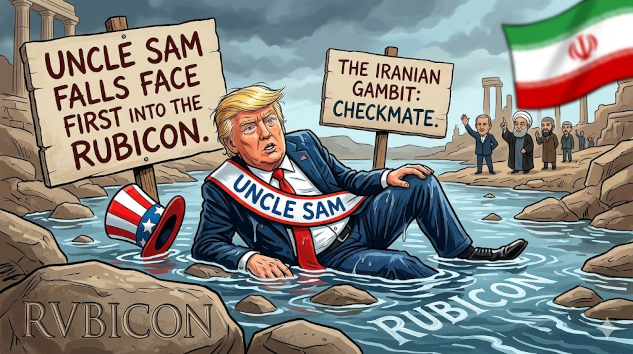
Wall Street hit a record high on Friday morning because a foreign minister in Tehran posted on X. That is the whole story in one sentence. The rest of this article is what that sentence actually means, and why it means a great deal more than the Dow is telling you.
In This Article
- What did Iran's foreign minister post that sent the Dow up a thousand points and oil down twelve percent?
- Why did seven weeks of bombing end on Tehran's terms instead of Washington's?
- What does the phrase "coordinated route" quietly reveal about who controls the Strait of Hormuz now?
- How much of Iran's missile capability survived the most intense air campaign since 2003?
- What does Dr. Strangelove have to do with the decline of the American empire?
- What are the real metrics of that decline, and how long has the slope been running?
- What did the schoolchildren of Minab pay for, and who cashed the check?
- What happens in the town after the sheriff stops being able to find it?
Nine forty-one Eastern, Friday morning, April 17, 2026. The sun was barely up over the New York Stock Exchange when Iranian Foreign Minister Seyed Abbas Araghchi sat down at his desk and posted a single sentence on X. He said the Strait of Hormuz was completely open for commercial vessels, on the coordinated route as already announced by the Ports and Maritime Organization of the Islamic Republic of Iran.
That sentence hit the market like a starter's pistol. U.S. crude plunged twelve percent. Brent dropped eleven. The ten-year Treasury yield fell to its lowest level since March. The Dow Jones Industrial Average jumped by 1,005 points. The S&P 500 crossed 7,100 for the first time in recorded history. The Russell 2000, the small-cap index, the index that most closely tracks the American domestic economy, made a fresh all-time high before most people on the East Coast had finished their first cup of coffee.
And here is the thing nobody on the financial channels wants to say plainly. Every one of those gains was a receipt for transferred power. The market doesn't care who holds the key. The market only cares that the door is open. And on Friday morning, the door opened because a man in Tehran decided it could. Not because the Navy cleared the mines. Not because the blockade worked. Not because any American action produced any American result. A foreign minister posted on X, and the most powerful financial system in human history responded like a dog that just heard its owner's car in the driveway.
What the Market Was Actually Cheering
Go back and read Araghchi's sentence one more time, slowly. The passage for all commercial vessels is declared completely open on the coordinated route, as already announced by the Ports and Maritime Organization of the Islamic Republic of Iran.
Every word is doing work. The strait is not reopened to the international shipping lanes that existed before February 28. It is reopened on Iran's coordinates, published by Iran's agency, for the window Iran specifies. When the ceasefire window closes, the permission closes with it. The coordinates don't close. The claim doesn't close. That is a permanent assertion of sovereignty over an international waterway dressed up as a temporary ceasefire courtesy, and the entire global financial system just stamped it with a record-high index value and called it good news.
This is what a transfer of power actually looks like in the twenty-first century. It doesn't arrive with a surrender ceremony on a battleship. It arrives with a tweet and a green candle. The empire doesn't fall in one afternoon. It quietly stops being the party everyone calls to ask permission; the calls start going somewhere else; the market adjusts its pricing accordingly; and nobody holds a press conference to explain what just happened.
Call it free trade if you need to. Call it a peace dividend. Call it whatever makes the anchor on the morning show sound authoritative. The price tape has a different opinion, and it doesn't lie to itself the way press secretaries do.
How We Got to the River
On February 28, the United States and Israel launched the largest coordinated strike on a sovereign nation since the invasion of Iraq in 2003. They called it Operation Epic Fury. Tomahawks from the fleet. HIMARS from land. B-2 stealth bombers, B-1 Lancers, and B-52s striking fortified ballistic missile facilities across Iran. Ten minutes into the opening salvo, the Israeli Air Force ran decapitation strikes on three separate meetings at Khamenei's residential compound, all three hit within thirty seconds of each other. The Supreme Leader of the Islamic Republic of Iran was killed along with members of his family.
That was the Rubicon. That was the irreversible act. The plan, to the extent there was one, was that the regime would crack like a dropped dinner plate. Our experts figured if you cut off the head of a snake, the snake dies—a fine theory, provided you aren't dealing with a civilization that’s been practicing for this specific audition since 1979. We spent a billion dollars to turn a Supreme Leader into a martyr, which is a bit like trying to put out a fire by hitting it with a heavy log. All we did was give the son a promotion, the military a reason to double the budget, and the neighbors a reason to bring over gunpowder and casseroles.
Within days, the Assembly of Experts elected Mojtaba Khamenei, the dead man's son, as the new Supreme Leader. The Revolutionary Guard set up checkpoints in every major city. The country went to war footing and stayed there. The regime didn't fracture. It consolidated, and it received a martyr, a dynasty, and a generation of grievance in the same week. That is not regime change. That is regime reinforcement with extra steps.
The bill for the opening strike was paid by people who had nothing to do with any of it. On the same February morning, a U.S. missile brought down the roof of the Shajareh Tayyebeh girls' elementary school in the town of Minab. A hundred and fifty-six civilians died. 120 of them were schoolchildren. The BBC, the New York Times, and multiple independent forensic investigations concluded the strike was American. A few hours later, a second American Precision Strike Missile hit a sports hall in Lamerd during a women's volleyball practice. Twenty-one dead, four of them children, a hundred wounded.
That is the face the American empire showed the world on the first morning of Operation Epic Fury. A school and a volleyball team. Whatever the generals were aiming at, that is what they hit. The ledger opened there and stays open no matter what the Dow does on a Friday morning.
Dr. Strangelove Was Right
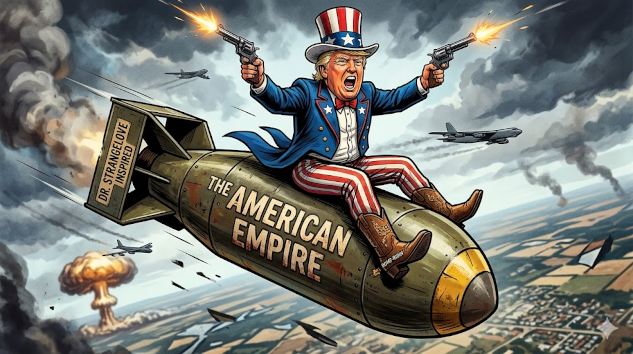
Uncle Sam as Trump rides a bomb labeled The American Empire, firing both pistols into the sky, Dr. Strangelove Inspired stenciled on the tail fin, mushroom clouds below.
Stanley Kubrick made Dr. Strangelove in 1964 because he understood something the generals in the Pentagon had not yet figured out. The danger wasn't malice. The danger was momentum. Slim Pickens didn't ride that bomb because he wanted to die. He rode it because riding bombs was what he did, because the system he lived inside had been built for exactly that purpose, and nobody had thought to install a circuit breaker.
General Jack D. Ripper didn't launch World War Three because he was evil. He launched it because the system gave him the authority and he used it based on a private obsession that nobody around him could verify or challenge. The machine worked exactly as designed. The result was the end of the world. That is the Strangelove condition: a system functioning perfectly, toward an end that nobody actually wanted, with nobody able to stop it once it was in motion.
The American military-industrial complex has been building toward a confrontation with Iran for thirty years. Targeting packages. Carrier group deployments. Regime-change doctrines cycling through think tank papers and National Security Council memos. The Islamic Republic has been the designated enemy since 1979, and the machinery for dealing with it has been refined and expanded and funded and positioned across three decades and a dozen administrations. When someone finally turned the machine on in February 2026, it did exactly what it was designed to do. It hit every target on the list. It killed the Supreme Leader. It knocked out a significant portion of Iran's ballistic missile infrastructure.
And the result was a dead Supreme Leader who became a martyr, a son who took the throne within the week, a hundred and twenty dead schoolchildren whose photographs circled the globe, an interceptor stockpile that is now classified because disclosing the number would be alarming, a Navy blockading a strait that Iran reopened without consulting the Navy, and a foreign minister's tweet setting the price of global oil at nine forty-one on a Friday morning.
The machine worked perfectly. The outcome was catastrophic. Slim Pickens is still riding the bomb. He is firing both pistols at the clouds and the clouds do not care, because clouds never do.
The Metrics of Decline Nobody Wants to Read Aloud
What happened on Friday morning was not an isolated embarrassment. It was a data point in a series of data points that has been running for two decades, and the series has a slope that anyone willing to look at it can see.
Start with the missile math, because it is where the war's logic becomes genuinely hard to look at with a straight face. Iran entered this conflict with what independent analysts describe as the largest missile and drone arsenal in the Middle East — over 3,000 ballistic missiles before you count the cruise missiles, and tens of thousands of mass-produced Shahed drones that Western sanctions were apparently not quite inconvenient enough to prevent. Each Shahed costs Iran roughly $35,000 to build. The Patriot interceptor missile fired to shoot it down costs $4 million.
Analysts at the Bruegel Institute in Brussels have taken to calling this using Ferraris to intercept e-bikes. By day twelve of the war, Iran had spent approximately $70 million on drones and forced the United States and its Gulf allies to burn through more than $2 billion in interceptors — a cost exchange ratio of 28 to 1 in Tehran's favor. The ballistic missile math is almost as ugly. Each Iranian ballistic missile costs between $500,000 and $2 million to produce. The SM-3 interceptor used to knock it down costs $36 million a shot — an 18 to 1 ratio that means every Iranian launch is a financial victory for Tehran whether the missile hits anything or not. Iran does not need to win this war. It just needs to keep sending the invoice. And we keep signing for the delivery.
Satellite photographs reviewed by CNN this week show front-end loaders clearing rubble from the tunnel entrances of Iran's underground missile cities during the ceasefire. Dump trucks hauling debris. The pause that was supposed to freeze the conflict is being used, in broad daylight, to reconstitute the exact weapons system the war was designed to destroy. The concept of the missile city, as a researcher at the James Martin Center explained, was always to eat the first attack, dig yourself out, and launch again. Iran built its entire deterrent around surviving exactly this war. And so far it has.
Now ask who is replacing interceptors faster. We’re currently over there shooting down twenty-thousand-dollar lawnmowers with three-million-dollar silver bullets. That’s not a military strategy; that’s a liquidation sale. We’re the only country in history that thinks it can get rich by spending five dollars to keep a nickel from hitting the floor. Eventually, you run out of fives, and the nickel is still right there where it started. Our factories, which used to make things like steel and hope, now mostly make complicated paperwork and classified excuses, while Iran is cranking out drones like a sourdough starter that won't stop growing.
Pull back further and the picture gets harder to look at. The dollar's share of global foreign exchange reserves has been falling for twenty years, from roughly seventy percent at the turn of the century to somewhere below sixty percent today. China has been settling oil trades in yuan with Saudi Arabia. The BRICS payment infrastructure, once dismissed as a fantasy, is operational. The petrodollar architecture that gave the United States its extraordinary ability to finance deficits and project power at relatively low cost is not collapsing on a Tuesday. It is eroding the way coastlines erode, grain by grain, tide by tide, until one morning you look out and the beach you remember is somewhere under the water.
The mediator in the biggest American military conflict in twenty years is Pakistan. Not Britain. Not France. Not Germany. Not any of the alliance structures that American diplomacy spent seventy years building and maintaining. Pakistan. The Gulf states that hosted American bases watched those bases absorb Iranian missiles and quietly accelerated their conversations with Beijing about alternative security arrangements. Saudi Arabia is hedging. The UAE is hedging. The countries that are supposed to be the bedrock of American influence in the region are reading the same tape the market is reading, and they are drawing the same conclusion.
What Rome Looked Like From the Inside
Empires never believe they are declining while they are declining. That is practically the definition of the condition. Rome spent the better part of a century winning tactical victories and losing strategic ground, paying barbarian armies to fight other barbarian armies, debasing the currency to fund adventures the tax base could no longer sustain, outsourcing the defense of the frontier to people whose loyalty was contractual rather than civilizational. The empire kept functioning. The legions kept marching. The Senate kept meeting. The bread and the circuses kept coming. And the center kept hollowing out, quietly, consistently, until one day the Visigoths walked into Rome and the remarkable thing was not that it happened but that anyone was surprised.
The mechanics of imperial decline are boringly consistent across civilizations and centuries. Overextension. Fiscal strain. Alliance erosion. The gap between military spending and military effectiveness. The privatization of public goods. The financialization of everything that can be financialized. The retreat from the kind of long-term investment in productive capacity that originally built the power the empire is now spending down. Each civilization wears a different costume but the dance is the same.
The American version of this dance has been running since the 1970s at minimum. That architecture meant that the empire's power became increasingly abstract, increasingly financialized, increasingly dependent on other nations choosing to conduct their business in dollars and park their savings in American debt. The moment those nations start making different choices, the runway gets shorter. They have been making different choices for twenty years. The runway is shorter.
Friday morning was not the beginning of this. Friday morning was a moment when the process became visible to anyone watching the tape. The most powerful navy in human history, sitting in the Persian Gulf, was priced at zero by the market the moment a foreign minister posted a tweet. That is not a scandal. That is an honest assessment. The market is very good at honest assessments when it is not busy lying to itself about something else.
The Sheriff, the Saloon, and the Empty Town
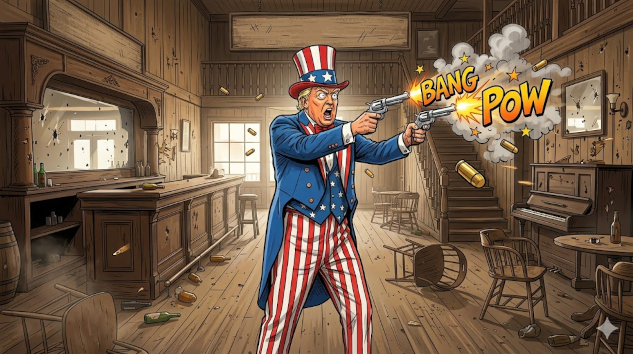
Uncle Sam fires both pistols into the ceiling of an empty saloon, BANG POW exploding from the barrels, brass casings flying, nobody home.
You have to feel a little sorry for the sheriff. Not much. But a little.
He is a type the American frontier produced by the thousands and Hollywood refined into something almost mythological. Rides into town like judgment itself, saddled up and came looking for you specifically. Kicks in the saloon door, both pistols out, the whole choreography practiced to a shine. Piano stops. Glasses freeze mid-lift. Every barfly in the place suddenly finds religion.
The entrance was perfect. History will record that the entrance was perfect.
What history will have a harder time recording is that, when the sheriff turned around to survey his conquest, the town had already moved. Not in a hurry. Not in a panic. Just quietly, sensibly, the way a town does when it has made a clear-eyed assessment of its options, loaded its most valuable items onto the available wagons, and relocated itself three miles up the road to continue its business without the interruption. The piano player took his piano. The bartender took the bottles worth taking. The barflies folded up their barstools with the resigned efficiency of people who have seen sheriffs before.
The saloon stood empty. The sign still read the same. The ceiling waited.
Now here is where the story turns on the man's character. A person of genuine self-knowledge rides after the town, or rides home, or at the very minimum sits down on a barstool and has an honest conversation with himself about the gap between his expectations and the available evidence.
This sheriff had a character entirely different from the others.
He fired both barrels straight into the ceiling. Not at anything. Not for any purpose. Just to fill the silence with something that sounded like authority. Then he blew the smoke off each barrel in turn, slow and satisfied, exactly the way he'd seen it done in every picture show he'd ever paid a nickel to watch. Tipped his hat to the empty mirror. Holstered up with the unhurried confidence of a man who has never once in his life confused the performance with the outcome.
He rode back to Washington and filed his report: "Town pacified. Historic results."
The Dow believed him—threw him a parade, in fact. It’s a strange sight, seeing Wall Street celebrate a ceasefire we didn't write. It’s like a man cheering because his neighbor finally decided not to burn his own house down. We’re so happy the door is open, we haven't stopped to notice that Tehran is the one who changed the locks and kept the only set of keys. We’ve been downgraded from "Landlord of the World" to "Tenant with a very polite landlord," and we’re throwing a party because the rent didn't go up on a Friday. But out in the Gulf, the carriers kept right on burning fuel in an empty sea, looking for a target that had the good sense to stop being a target.
The distinction is everything, and almost nobody on television this morning stopped to make it.
Out in the Gulf, the carriers kept burning fuel. The admirals kept giving briefings with laser pointers and color-coded maps. The blockade that nobody was observing remained technically in effect. And somewhere east of Tehran, in a building that survived seven weeks of the most expensive air campaign on the planet, a foreign minister who had outlived a Supreme Leader sat down at his desk, opened a map of the strait that his country's agency had already published, and considered which route the world's oil would take tomorrow.
That is where we are. That is the Iranian gambit completed. That is the Hormuz checkmate delivered. And that is Dr. Strangelove's bomb still in the air, with the man on top still firing at clouds, and the clouds still not caring, because they never do.
But the town moved. The town is building something three miles down the road. And it is doing it without waiting for anyone's permission. That is worth noticing, not because it means we are doomed, but because it means the world keeps organizing itself even when the old organizing principle has ridden its bomb past the point of no return.
The world keeps building the next thing. It always has. The trouble is, our leaders have reached a point where they’d rather lose a war and have a good PowerPoint presentation than win one and have nothing to show the committee on Tuesday. We’re still watching the smoke clear from the saloon ceiling, admiring the way we practiced the draw, while the rest of the world has already moved the piano to the new town three miles away. We’re the only ones left in the room, and we’re the only ones who think the empty chairs are impressive.
About the Author
 Robert Jennings is the co-publisher of InnerSelf.com, a platform dedicated to empowering individuals and fostering a more connected, equitable world. A veteran of the U.S. Marine Corps and the U.S. Army, Robert draws on diverse life experience, from real estate and construction to building InnerSelf.com with his wife, Marie T. Russell, bringing a practical, grounded perspective to life's challenges. InnerSelf grew from InnerSelf Magazine, founded by Marie T. Russell in 1985, which became InnerSelf.com in 1996. Decades later, InnerSelf continues to inspire clarity and empowerment.
This article is licensed under a Creative Commons Attribution-NonCommercial-NoDerivatives 4.0 License. You may share it with attribution to Robert Jennings, InnerSelf.com, and a link back to the original article at InnerSelf.com. Commercial use and derivative works are not permitted without permission.
Further Reading
-
Chokepoints: American Power in the Age of Economic Warfare
This book examines how control over global trade routes, financial systems, and strategic infrastructure shapes modern power. It explores how nations leverage access, restriction, and coordination points to influence markets and geopolitical outcomes in an interconnected world.
Amazon: https://www.amazon.com/exec/obidos/ASIN/0593712978/innerselfcom
-
Balance: The Economics of Great Powers from Ancient Rome to Modern America
This work traces the economic foundations of major powers across history, focusing on how fiscal policy, military spending, and trade imbalances influence long-term stability. It provides a structured analysis of how nations rise, sustain influence, and eventually encounter systemic constraints.
Amazon: https://www.amazon.com/exec/obidos/ASIN/1476700257/innerselfcom
-
Reconstructing Strangelove: Inside Stanley Kubrick's Nightmare Comedy
This book offers an in-depth look at the creation and meaning of Kubrick’s film, including its portrayal of nuclear strategy, institutional behavior, and Cold War thinking. It unpacks the cultural and political context that shaped one of the most enduring critiques of modern military logic.
Amazon: https://www.amazon.com/exec/obidos/ASIN/0231177089/innerselfcom
Article Recap
The Iranian gambit closed with a tweet and a record-high Dow. The Hormuz checkmate transferred the practical control of the world's most critical energy chokepoint from the United States Navy to an Iranian foreign minister's X account. The American empire decline that made this possible did not begin on February 28. It has been running for twenty years through eroding dollar dominance, hollowed industrial capacity, a missile production gap, and alliance structures quietly shopping for alternatives. Dr. Strangelove's bomb has been in the air for a while. Friday morning was just the moment the altimeter became impossible to ignore.
#IranianGambit #HormuzCheckmate #AmericanEmpireDecline #DrStrangelove #StraitOfHormuz #IranWar2026 #OilPrices #DowRecord #Macgregor #Geopolitics #Rubicon #Tehran #PetrodollarEnd #EmpireDecline