







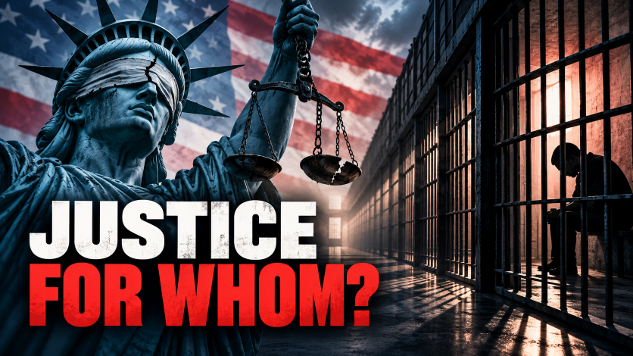
In This Article
- How does American justice actually work when you cannot afford to pay for it?
- What do death row exoneration rates tell us about who we are willing to execute?
- Why are there more mentally ill people in US prisons than in hospitals?
- What does the war on drugs really mean for property rights and civil liberties?
- Are we repeating patterns from history that we swore we never would?
There is a particular kind of arrogance that comes naturally to nations that believe their own press releases. The United States has spent decades presenting itself as the global sheriff of human rights, wagging a finger at China, Russia, and anyone else whose conduct offends the international community. It is a fine hobby, if you can afford it. But when nearly half the people on death row in major American states turn out to be innocent, the moral high ground starts seeming more like a mudslide.
The Price Tag on Justice
In the United States, justice is available to everyone. It just costs more than most people have. The Constitution promises legal representation, and the system delivers it in the form of public defenders who are frequently overworked, underfunded, and stretched so thin that a serious review of a client's case becomes a benefit rather than a standard. This is not an attack on individual public defenders, many of whom are dedicated people doing impossible work — it is an observation about a system designed to process poor people efficiently, not to protect them reliably.
The country has more lawyers per capita than any other nation on earth. And and it is still desperately short of lawyers who are primarily concerned with justice rather than billing hours. That gap is where innocent people fall through.
Death Row and the Arithmetic of Innocence
Consider the numbers out of Illinois. Over a span of twenty-one years, eleven people on death row were exonerated and walked free. In that same period, eleven people were executed. If you are comfortable calling that a coincidence, you have a higher tolerance for risk with other people's lives than most of us do. But Illinois was not alone. Across Florida, Illinois, Georgia, Arizona, Oklahoma, New Mexico, Louisiana, California, and Ohio, 139 people were executed. Another 62 were exonerated. That is nearly fifty percent of the total. Nearly half.
Texas was excluded from that calculation, not to protect Texas, but because including it would have made the numbers even harder to sit with. Texas has executed roughly one and a half times as many people as all those other states combined. The pace alone should give anyone pause.
It used to be said that it is better to let ten guilty men go free than to convict one innocent man. That principle built much of what we call Western justice. Somewhere along the way, the ratio flipped, and nobody held a press conference to announce it.
Mental Illness Behind Bars
Roughly fifteen percent of the people currently incarcerated in the United States are mentally ill. There are more mentally ill people in American prisons right now than in American hospitals. At some point in the country's history, there was a collective agreement that mentally ill people needed treatment, not punishment. Communities built institutions, imperfect ones certainly, but places oriented around care rather than cages.
What replaced that approach was a corrections system that has neither the tools nor the mandate to treat mental illness, only to contain it. Putting a person with schizophrenia in a cell does not cure schizophrenia. It makes it worse. The environment almost guarantees that. And when those people are eventually released, they go back into communities more damaged than when they arrived, without treatment, without support, and often without housing.

Who Ends Up in the System and Why That Is Not an Accident
There are more people incarcerated in the United States than in any other industrialized nation. When you look at who those people are, the picture clarifies quickly. They are overwhelmingly poor. They are disproportionately minorities. Estimates suggest that around seventy-five percent of Black men in the United States have experienced some form of judicial supervision at some point in their lives. That statistic is not the result of one community committing more crime. It is the result of a system that surveils, stops, charges, and convicts certain communities at rates that have nothing to do with equal protection under the law.
The pattern has historical company that nobody wants to name out loud. The concentration of the powerless, the disenfranchised, and the mentally ill into prison populations that function outside normal civic life is not a new idea. It has been tried before, by governments that the United States spent considerable blood and treasure defeating. History has a way of coming back when people stop paying attention.
The War on Drugs as a Mechanism of Control
The war on drugs gave American governments a flexible tool. It justified expanded policing, mandatory minimum sentences, and perhaps most remarkably, the erosion of property rights that Americans once considered sacred. Civil asset forfeiture laws now allow governments in many states to seize property without charging the owner with a crime. Not convicting them. Not even charging them. Just taking what they own, on suspicion, with the legal burden placed on the owner to fight the government to get it back.
That is not a feature of a free society. It is the kind of policy that shows up among regimes whose human rights records we publicly deplore. The drug problem in the United States is real, and it is serious. But putting an enormous portion of the poor population behind bars has not solved it. It has mostly just moved suffering from one visible place to another less visible one.
What We Traded Away and What We Got for It
Americans gave up a remarkable collection of liberties in exchange for a feeling of safety. Not actual safety — the feeling of it. The security theater of mass incarceration reassures people who do not have to live inside the system that something is being done. The people living inside it know better. They know that safety and justice aren't the same thing, and that a country can have very elaborate mechanisms for punishing people while delivering very little of either.
The question worth sitting with is not whether the system has flaws — every honest person already knows it does. The question is who benefits from those flaws staying exactly as they are. When you follow that thread, the picture that emerges is not flattering. But it is important. A society that exports lectures on human rights while running a domestic system this tilted is not practicing moral leadership. It is practicing a very old and recognizable kind of hypocrisy.
The Moment Before It Becomes Too Late to Ask
History has a shelf life for course corrections. There is a period in which a society can look at itself, recognize what it is doing, and change direction. After that window closes, historians step in and ask how ordinary people let it happen — how the machinery got so normalized that citizens stopped seeing the people inside it as citizens. The brown shirts did not seize Germany overnight. They moved incrementally, each step normalized by the one before it, until the unthinkable had simply become policy.
That comparison is uncomfortable. It is meant to be. Discomfort is the beginning of accountability, and accountability is the only thing that has ever actually changed anything. The United States has the institutions, the legal tradition, and the stated values to do better. Whether it has the will is a question that only its people can answer, and the clock on that answer is not standing still.
About the Author
 Robert Jennings is the co-publisher of InnerSelf.com, a platform dedicated to empowering individuals and fostering a more connected, equitable world. A veteran of the U.S. Marine Corps and the U.S. Army, Robert draws on diverse life experience, from real estate and construction to building InnerSelf.com with his wife, Marie T. Russell, bringing a practical, grounded perspective to life's challenges. InnerSelf grew from InnerSelf Magazine, founded by Marie T. Russell in 1985, which became InnerSelf.com in 1996. Decades later, InnerSelf continues to inspire clarity and empowerment.
This article is licensed under a Creative Commons Attribution-NonCommercial-NoDerivatives 4.0 License. You may share it with attribution to Robert Jennings, InnerSelf.com, and a link back to the original article at InnerSelf.com. Commercial use and derivative works are not permitted without permission.
Recommended Books
The New Jim Crow: Mass Incarceration in the Age of Colorblindness by Michelle Alexander — A groundbreaking examination of how the American criminal justice system functions as a system of racialized social control.
Just Mercy: A Story of Justice and Redemption by Bryan Stevenson — A deeply personal account of fighting for the wrongly condemned and the broken parts of the justice system that put them there.
Imprisoning Communities: How Mass Incarceration Makes Disadvantaged Neighborhoods Worse by Todd R. Clear — A rigorous look at how high incarceration rates destabilize communities rather than protect them.
Article Recap
The American criminal justice system disproportionately targets poor, minority, and mentally ill populations while high death row exoneration rates and civil asset forfeiture laws expose a pattern of institutional injustice that contradicts the nation's stated commitment to human rights. When nearly fifty percent of death row inmates in examined states were later exonerated, and property can be seized without a charge being filed, the gap between American ideals and American practice demands urgent public reckoning.
#CriminalJusticeReform #MassIncarceration #HumanRightsCrisis #DeathRowExonerations #JusticeSystem #CivilRights #MentalHealthInPrisons #WarOnDrugs #SystemicInjustice #AmericanJustice