







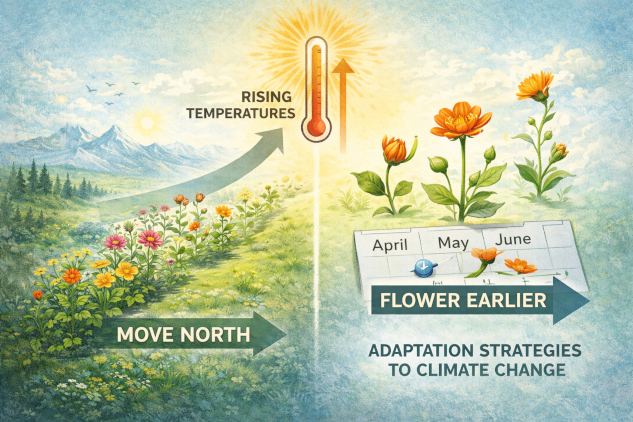
Plants reacting to climate change have two strategies to deal with increasing warmth: they escape the heat either by moving towards the poles, or by flowering sooner.
As climate change intensifies, plants are adapting through migration or altered flowering times. Researchers have uncovered patterns in how various species respond to warming temperatures, revealing insights into their survival strategies. These findings highlight the complexities of plant behavior and offer valuable principles for conservation efforts.
In This Article
- What challenges do plants face due to climate change?
- What mechanisms do plants use to adapt to warming?
- How do plants shift their ranges or alter flowering times?
- What practical applications arise from understanding plant responses?
- What are the limitations of current research on plant adaptation?
Plants reacting to climate change have two strategies to deal with increasing warmth: they escape the heat either by moving towards the poles, or by flowering sooner. Scientists are one step closer to solving one of the puzzles of the natural world’s response to climate change: why one species migrates and another does not.
Tatsuya Amano of the University of Cambridge in the UK and colleagues report in the Proceedings of the Royal Society that there could be a relatively simple explanation, especially for plant behaviour. Those that can make new colonies move north (or south, in the southern hemisphere) to take advantage of changing temperature regimes. Others simply shift the time zone: they flower earlier.
The response of flora and fauna to climate change is not a simple one: all sorts of influences are at play, including changes in habitat and in farming methods, in competition from alien introductions, and in the introduction of new kinds of predator.
But over the decades, scientists have been able to measure distinctive shifts. In alpine Switzerland, plants, butterflies and birds were all observed to move uphill as temperatures shifted through the decades. In Britain, some butterfly populations were observed to extend their range northwards while others were less able to take advantage of the opportunity to exploit new territory.
Dr Amano and his partners – from Britain, Poland and Germany – looked at a long sequence of historical records to explore the responses of plants. The theory is that over evolutionary time, each species finds a favoured “niche” that suits it best, and occupies it.
As climate conditions change, so should the ideal niche, and plants should shift their ground or respond in some other way. All the research requires is a lot of data, collected over hundreds of years.
General Principles of Plant Adaptation
"Britain is the ideal study system for this purpose because historical changes in first flowering dates have been estimated for 405 plant species by applying a hierarchical model to almost 400,000 observation records throughout the country”, say the authors, “and records on spatial distribution are available for 6,669 higher plant taxa throughout Britain at two census periods” (a taxon is a group of natural populations judged by taxonomists to constitute a unit).
They were able to work from 395,466 records of 405 flowering species collected between 1753 and 2009, held by the UK Phenology Network.They also had access to the oldest set of weather records on the planet, the Central England Temperature series, recording daily temperatures since 1772.
By using sophisticated mathematical techniques and a lot of data, the team were able to settle at least one very general principle: if a plant could not take advantage of warmer weather by flowering earlier then there was a greater likelihood that it would shift its range northwards. And there was a complementary relationship: if a plant could not change its ground, it changed its phenology. [Wikipedia: Phenology is the study of periodic plant and animal life cycle events and how these are influenced by seasonal and interannual variations in climate, as well as habitat factors (such as elevation).]
The finding gives conservation scientists some more general principles to apply. It also reveals some of the characteristics that might indicate how a species might be predicted to respond. The word “might” is important here. Their findings, the authors say, “need to be carefully interpreted, as our models generally had a low explanatory power.”
About the Author
 Tim Radford is a freelance journalist. He worked for The Guardian for 32 years, becoming (among other things) letters editor, arts editor, literary editor and science editor. He won the Association of British Science Writers award for science writer of the year four times. He served on the UK committee for the International Decade for Natural Disaster Reduction. He has lectured about science and the media in dozens of British and foreign cities.
 Book by this Author:
Science that Changed the World: The untold story of the other 1960s revolution
by Tim Radford.
Click here for more info and/or to order this book on Amazon. (Kindle book)
Further Reading
-
Phenology: An Integrative Environmental Science
This book explains how timing-based life-cycle events, especially flowering and leaf-out, track temperature shifts and seasonal cues. It directly supports the article’s core idea that many plants adapt to warming by changing phenology rather than relocating. It also helps interpret long-term datasets like historical flowering records and temperature series.
Amazon: https://www.amazon.com/exec/obidos/ASIN/3031750268/innerselfcom
-
The Hidden Life of Trees: What They Feel, How They Communicate
This book offers an accessible view of trees as responsive organisms embedded in networks of stress, support, and environmental signaling. It complements the article by adding ecological texture to why some species do not simply move poleward, including constraints tied to establishment, disturbance, and local conditions. It helps readers grasp why plant responses can look simple in principle but complex in practice.
Amazon: https://www.amazon.com/exec/obidos/ASIN/1771642483/innerselfcom
-
The Ecology of Plants
This textbook provides the conceptual backbone for niche theory, range limits, and the tradeoffs that shape whether species track climate by shifting geography or by changing timing. It connects directly to the article’s question of why one species migrates while another does not, grounding that question in dispersal, demography, competition, and environmental filtering. It is also useful for conservation planning that depends on realistic expectations of species responses.
Amazon: https://www.amazon.com/exec/obidos/ASIN/1605358290/innerselfcom
Article Recap
Plants facing climate change either migrate to cooler areas or adapt their flowering times. Understanding these strategies can inform conservation efforts, but researchers caution that models may not fully capture the complexity of plant responses.
#InnerSelfcom #ClimateChangeAdaptation #PlantMigration #Phenology #ConservationScience #Biodiversity