






In This Article
- Why not caring can become a defense against emotional pain and overwhelm
- How dropping out can unintentionally surrender our ability to influence what happens
- Why acknowledging suffering is necessary before healing can begin
- How compassion can coexist with standing firmly against cruelty and injustice
- Why we are already making a difference, whether through our actions or our inaction
"Frankly, my dear, I don’t give a damn."
— Rhett Butler, Gone with the Wind
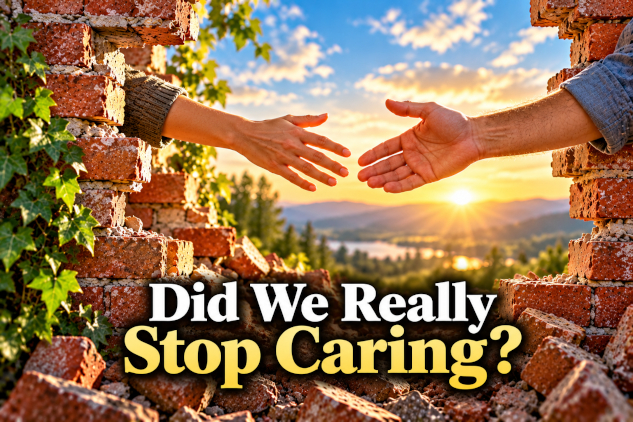
Lately, I’ve found myself wondering whether we’ve stopped caring about the problems in our world. But perhaps the more important thing to reflect upon is why.
Has caring become so painful that not giving a damn starts to feel like self-protection?
Is distancing ourselves from the problem, or problems, a defense mechanism?
Do we say we don’t care because, if we admit that we do care, it will hurt more, and we may feel like we need to do something to make a difference?
Spoiler alert: no matter what, we do make a difference.
When Dropping Out Seemed Easier
Those of us who are part of the baby boomer generation, in great majority, participated in the dropping-out phase of that generation. We may have tried to change things during the Vietnam era, and it didn’t work. So rather than keep hitting our heads against the wall, many of us decided to just enjoy life.
And don’t get me wrong. I’m all for enjoying life. It’s been one of my favorite things to do. However, I too dropped out. I not only dropped out of university, I dropped out of participating in what was termed politics, and what we at InnerSelf call Social Consciousness.
However, politics, not the way we usually think of it now, but in its basic meaning, is the managing of a country or community. So by opting out of politics, what we did, and possibly what other generations are doing, is leave the governing and direction of our communities and of our country up to the people who were interested in having that power, perhaps for their own self-serving needs.
We gave up the control of our life to somebody else. After all, we were raised to do that.
As children, our parents were the ones who directed our life, but the process of growing into adolescence and adulthood is where we step forth and claim our authority and our autonomy. That’s where we decide what we want to do with our life, where we want to live, how we want to live, and who we want to live with.
Yet even in that process, some of us gave up our autonomy, whether by choosing a career we didn’t love because it offered money and retirement benefits, or possibly choosing a spouse because of a mental decision rather than a heart-based decision.
But I digress a bit. Let’s go back to looking at whether we stopped caring.
Well, maybe that wasn’t really digressing, now that I think about it. Because perhaps that’s where some of us stopped acting like we cared, and it was a self-defense mechanism. If our life was not bringing us joy, if our life was not loving, if our life was not meaningful, if our life carried catastrophes out of our control, we may have decided to pretend everything was fine. Why? So we wouldn’t have to feel the pain, the sorrow, and the lack of fulfillment.
Caring Can Hurt
If you’ve lived any of your life behind a protective wall, afraid that if you start to care it will be overwhelming, perhaps it’s time to look past that wall.
If we admit that we do care about the children killed in classrooms, or the people starving around the world and even in our own country, if we acknowledge and start to care about the injustices and inequalities, we may fear that it will simply be too much.
It’s a bit like people who hold back their anger or their tears because they’re afraid that if they open that door, the floodgates will burst and they will be overwhelmed with emotions they don’t know how to deal with.
But here’s the problem. We’ve backed ourselves into a corner.
In front of us are the inequalities, the hatreds, the injustices, and the fears that are present in our day-to-day life and in our society. We may have tried to ignore these by self-medicating with alcohol, recreational drugs, social media, or funny cat videos. But at some point, we’ve backed ourselves so far into that corner that we’ve got nowhere to go except to face reality.
Is it frightening? Yes.
Will it hurt? Probably.
Will it overwhelm us? Temporarily, maybe.
Facing the Mess
It’s a bit like allowing bags of garbage to pile up outside your door for months, years, or decades. Once you decide to do something about it, it may seem overwhelming at first. After all, you’re dealing with years of buildup that you’ve been ignoring.
But is it hopeless? Absolutely not.
I’m a firm believer in: If there’s a will, there’s a way.
So the first step is for us to be willing to look, to see, and to acknowledge the mess that we are in. And that mess includes the division between people, the us-against-them, the judgments, the hatred, the apathy, and the feelings of helplessness.
But if we’re still alive, we can still take action. We can still change. We can still move forward.
We don’t have to be stuck in a rut, tied to an attitude or behavior. We can change, and the first step is to start actively caring about our own self, about the people around us, and about the world we live in.
Closing our eyes doesn’t make any of it go away. It only makes it easier for us not to see. And for others to get away with murder, as the saying goes.
What Did We Do With Our Life?
If we are asked to account for our life at the end of it, and we are asked, “What did you do to make the world a better place? What did you do to make other people’s lives better? What did you do to make a difference?” what would we be able to say?
And, how would we feel about our answer?
Would we have a sense of pride that, whether or not we succeeded, we tried to make a difference? We took action. We spoke up. We opened our eyes and our awareness to see what needed to be changed, and we asked ourselves what we could do. And we did what we could.
Perhaps it’s time to give ourselves permission to start caring about the state of the world and about the lives of the people in it.
Because we are all connected.
There Is No Separate “Them”
The sentence that comes to mind is from the Bible, when Jesus says that what we do to the least of these, we do to him. So in the same way, whatever is done to the least of these, planet-wide, is done to us because we are all connected.
We are one big human family of different sizes, shapes, colors, genders, religions, nationalities, and beliefs. Yet, being different does not mean being separate. We are all living in the same home, Planet Earth. And when one part of our human family is in danger, the rest of us are affected as well.
Our choices affect other people. Their choices affect us. What takes place in one part of our shared home eventually affects the rest of it.
We Can’t Heal What We Refuse to See
Unless we acknowledge the problems around us, how can we heal them?
If you have a broken arm and refuse to acknowledge that it’s broken and keep taking pain pills so you can’t feel it, how will it ever heal? Putting a Band-Aid on our broken society is not going to help. We need to look at it honestly and see what we can do to fix it, to heal it.
Maybe it’s speaking up when someone, either in your presence or online, spews hatred and bigotry. Maybe it’s saying a kind word when you see that someone is in need of one.
Whatever we can do, whether it’s a big action or a small one, the main thing is to do something. To take the risk of speaking out of turn. To take the risk of saying, “That behavior is not acceptable.”
And also, to stop feeding the outrage machine. Outrage, hatred, and anger can keep us locked into anguish and pain. Love, caring, and compassion open another door.
Compassion Doesn’t Mean Looking Away
We’ve been raised with all these beliefs about separation, whether of gender, race, religion, country, money, or whatever. But perhaps it’s time to recognize that being different does not mean being separate.
It’s time to look at even the worst criminal, the worst politician, or the worst whatever and look for the hurt child that resides within them. Giving them more judgment, anger, blame, shame, and outrage will not heal their belief in separation.
The only thing that will heal the separation, that will build a bridge across the divide between hearts and minds, is to care. To care for the well-being of others. To wish them the best even when their behavior does not warrant our approval. To seek ways to love and accept others as human beings without accepting their destructive behavior.
This doesn’t mean we don’t speak up against injustice and cruelty. On the contrary. That’s part of caring.
Sometimes caring means saying no. Sometimes caring means standing between someone who is being hurt and the person doing the hurting. Sometimes caring means refusing to remain silent.
Compassion does not require us to tolerate cruelty. We can care for the victims while recognizing that the perpetrators are human beings. One does not cancel out the other. We can oppose what someone is doing without needing to hate the human being who is doing it.
Perhaps that is one of the hardest forms of caring.
We Have Met the Healer
I was reading an article the other day where the author was bemoaning the statement, “We have met the enemy, and he is us.” He felt that was a negative perception of humanity.
But, unless we acknowledge the problem, we cannot heal it.
So yes, we have met the enemy, and it is us.
But we have also met the healer, and it is also us.
We are both the light and the dark. Whatever we have created, participated in creating, or allowed to be created in our world, once we acknowledge our participation and our responsibility, we can begin healing it.
This isn’t about condemning ourselves. It’s about recognizing that while we have some responsibility for what has been created, we also have some power to change it.
If you wake up every morning with a hangover, until you acknowledge that your own behavior is causing the problem, you cannot fix it. First, we acknowledge the problem and our responsibility in it. Then we choose to care about ourselves and the world around us enough to change our behavior.
Perhaps the same thing applies to our collective life. We first have to be willing to see what we are participating in before we can choose something different.
The Buck Stops Here
We have lived too long in an us-and-them world. We’re the good guys and they’re the bad guys.
But the truth of it is that we all have a good guy and a bad guy inside of us. And while we may not personally be responsible for some terrible act taking place in the world, we may have participated in allowing the circumstances in which those acts became possible.
And this isn’t about blame or judgment or guilt. This is about facing the facts and saying, enough is enough. The buck stops here, and it stops now.
No, we cannot single-handedly change the world overnight. But when many of us start, one by one, doing something, then it adds up. So we start with one.
We start with ourselves. Then we see how we can help the person next to us. How we can make a difference for them. And maybe it’s simply by stopping the judgment. Stopping the criticism. Stopping the condemnation.
And we start looking for the healing. Looking with compassion. Looking for the love.
Because whether we realize it or not, we are already making a difference. What we do matters, but so does what we don't do. The question isn't whether we affect the world around us. The question is what kind of difference we choose to make.
It’s Time to Give a Damn
Perhaps we’ve spent enough time walking away. Perhaps we’ve spent enough time pretending we don’t care because caring hurts too much.
Perhaps we’ve spent enough time thinking that the problems are unmanageable. Or somewhere along the way, we became convinced that nothing we did would matter anyway.
But it does matter. We matter.
We don’t have to fix the whole world today. We don’t even have to know how to fix it.
We simply have to be willing to care enough to take the next step.
One person caring may not seem like much. But it’s a beginning.
And then another person cares.
And another.
And another.
Perhaps that’s how we begin finding our way out of this mess. Not by waiting for somebody else to fix everything. Not by pretending we don’t see it. Not by protecting ourselves by looking away, or distancing ourselves, or comforting ourselves with the words “I can’t do anything about it anyway.”
But rather, by opening our eyes, opening our hearts, and deciding that whatever we can do, however small it may seem, we are willing to do.
As the song says: What the world needs now is love, sweet love. No, not just for one, but for everyone.
So, yes, it’s time to give a damn.
About The Author
 Marie T. Russell is the founder of InnerSelf Magazine (founded 1985). She also produced and hosted a weekly South Florida radio broadcast, Inner Power, from 1992-1995 which focused on themes such as self-esteem, personal empowerment, and well-being. Her articles focus on transformation and reconnecting with our own inner source of joy and creativity.
Creative Commons 3.0: This article is licensed under a Creative Commons Attribution-Share Alike 4.0 License. Attribute the author: Marie T. Russell, InnerSelf.com. Link back to the article: This article originally appeared on InnerSelf.com
Related Books:
I found three that fit the article unusually well without falling back on the standard Brené Brown/Thich Nhat Hanh-type recommendations. I also verified the editions so the Amazon links use the correct 10-character ISBN/ASIN with your innerselfcom associate ID. (American Psychological Association)
Related Books
* The Amen Effect: Ancient Wisdom to Mend Our Broken Hearts and World — Sharon Brous
When the world feels fractured, it can be tempting to protect yourself by withdrawing. Sharon Brous offers another path: showing up for one another in moments of pain, joy, loneliness, and uncertainty. Drawing on spiritual wisdom, human connection, and practical experience, this book shows how caring for one another can become an antidote to isolation and a way of rebuilding our shared humanity. Published in 2024.
Order "The Amen Effect" on Amazon
* Being the Change: A Guide for Advocates and Activists on Staying Healthy, Inspired, and Driven — Dara G. Friedman-Wheeler and Jamie S. Bodenlos
Caring about injustice and suffering can become exhausting, particularly when the problems seem larger than anything one person can change. This practical 2023 book addresses that dilemma directly, helping readers remain engaged without allowing discouragement, stress, or burnout to drive them toward apathy. It offers a useful companion for anyone asking how to keep giving a damn without becoming overwhelmed by everything that needs changing.
Order "Being the Change" on Amazon
* How We Show Up: Reclaiming Family, Friendship, and Community — Mia Birdsong
Mia Birdsong challenges the idea that we are meant to navigate life primarily as isolated individuals. She examines how disconnection and excessive individualism can leave us lonely and powerless, while community, vulnerability, generosity, accountability, and interdependence can restore a sense of belonging and agency. This book provides a thoughtful path from isolation toward actively caring for one another.
Order "How We Show Up" on Amazon
Article Recap:
When caring becomes painful, apathy can become a protective wall. But withdrawing doesn’t mean we stop affecting the world around us. By facing what hurts, choosing compassion without tolerating cruelty, and taking responsibility for our own actions, we rediscover our ability to make a difference.
#Caring #Compassion #Apathy #MakingADifference
#PersonalResponsibility #PersonalEmpowerment #SocialConsciousness
#EmotionalHealing #Interconnectedness #InnerSelfcom