Life Changes
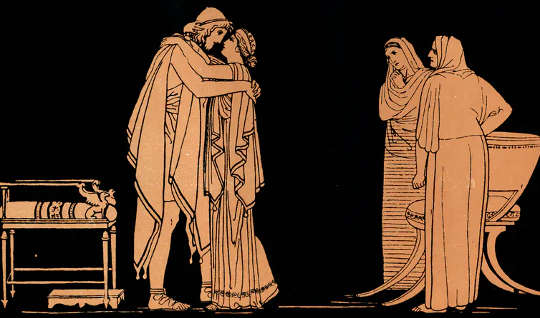
Healing Through Storytelling: Lessons from The Odyssey
The journey of Odysseus in Homer's 'The Odyssey' offers profound insights into healing...









It is no accident that arguably the most erotic line of English poetry is all prepositions. The essence of love, at least of passionately romantic love, is revealed in its very grammar.

Early on, relationships are easy. Everything is new and exciting. You go on dates, take trips, spend time together and intentionally cultivate experiences that allow your relationship to grow.

Men seem more hesitant about both making friends and celebrating their friendships. On Feb. 13, women will celebrate Galentine’s Day, a holiday trumpeting the joys of female friendships.

Americans celebrate love on Feb. 14, Valentine’s Day — a holiday named for Saint Valentine, a third-century Roman clergyman who secretly performed weddings for soldiers forbidden to marry under Emperor Claudius II.

What makes a good relationship? A willingness to surrender one’s heart—totally and without reservation to your Beloved—and to trust that, when you leap together into the precipice of the unknown, you will be able to reach confidently for one another and find solace or joy in equal measure through that loving communion.

Human beings are social animals—we all need some degree of interaction with other humans for basic survival as well as psychological health. Spending time with empathetic, optimistic, open-minded people and weeding out those who have the opposite qualities will boost your mood, elevate your motivation, and improve your health.

People say they want everyone to have cool heads and polite exchanges of views, even during important political debates.

We often talk about "wanting to be spiritual," but being spiritual and taking care of our everyday affairs are exactly the same thing. There is no difference. With clarity we become ordinary -- simply taking care of whatever comes before us. In this process, we develop trust that...

Research has shown that youth who participate in sports leagues are eight times as likely to be active in their early 20s than those who don’t participate.

After many years of coaching and leading seminars, I have discovered two areas that most people ask about most frequently: prosperity and relationships. Most people are looking for their love mate, or, if they have one, are seeking a better connection.
How can one be afraid of the past when it has already happened? Yet when one looks closely at the fears we have for the future, we see they are often repetitions of old fears, or of things that have happened to us or to others in the past. What is it you fear? Look back at your past and see...

A long, long time ago, when human beings were not so fixed in their physical bodies as they are today, there lived a man (or was it a woman?) who made for himself a marvelous mask -- a mask that could pull many faces.

Americans are deeply ambivalent about the solitary person in our midst. On the one hand, the lone hero is much admired in national folklore. On the other side of our ambivalence is the belief that to be alone, even temporarily, is to have been abandoned and to be sunk in a black misery of loneliness.

Everything we do in life is a relationship. We have a relationship with money, with our body, and with our car. We have a relationship with everything! Relationships are difficult and challenging spiritual practices. They give us the opportunity to test our skills of communication, intimacy, authenticity, and integrity.

Here’s something fascinating about stories that recount a major change of heart.

We experience repetitious patterns in relationship, work, or health; different actors are showing up to play out the same role. Eventually we recognize that it cannot be an accident that the same type of people keep doing the same things; it is we who have drawn them according to the signals we are radioing to central casting.

About one-third of women using contraception use the pill. But how effective is it?

One question the ABC’s promotional material focused on was “Are you lonely?”

How did homosexuality in humans evolve? Typically, this question is posed as a paradox.

Major depression among teen girls in the U.S. increased even more – from 12% in 2011 to 20% in 2017.

People who are married or in committed relationships are healthier, wealthier, and happier. So why do more than 60 percent of marriages end in divorce?
The journey of Odysseus in Homer's 'The Odyssey' offers profound insights into healing...

Fostering a legacy of joy empowers individuals to inspire authentic self-expression in...

Junk emotions like anxiety, anger, and jealousy can hinder personal well-being and...

Awareness meditation shifts focus from traditional breath techniques to observing...

The exploration of precognitive dreaming reveals a profound interconnectedness within...

Negative moods can linger and affect overall well-being, but identifying their triggers...

A rare celestial formation is quietly reshaping the foundations of everything we know —...

You don't need a week in silence at a mountain retreat to feel spiritually alive again....